Showing posts with label Lisbon Iowa. Show all posts

Tuesday, November 6, 2018

Only in Iowa - Seed Corn in Town


Many backyards in Iowa have vegetable gardens that include sweet corn. This display, however, takes the iconic plant to a new level. Where else but in a corn state like Iowa does the homeowner not only plant corn as a decorative crop in the front yard but finishes it off with a seed corn sign, like those found along countless rural roads?

Sunday, November 20, 2016

Remembrance Day Gettysburg - Iowa Connection


This year is the 153rd anniversary of President Abraham Lincoln's Gettysburg Address delivered at the dedication ceremony of Soldiers' National Cemetery. Remembrance Day is an annual event to reflect upon the Gettysburg battle, watch modern reenactors parade through Gettysburg and hear Lincoln's famous speech. While I have detailed the Iowa connection before in the 42N blog (post here), today's anniversary of the Lincoln speech (actually it was yesterday) served as a reminder to re-photograph the monument in the Lisbon, Iowa cemetery before the winter snows come.


I submitted a story idea to the Cedar Rapids Gazette some time ago for their Sunday column about area history. The reporter did a great job in crafting the story of how the boulder got from the battlefield to Lisbon, Iowa. It is only one of two boulders to have been removed from the Gettysburg battlefield for display purposes. Read the Gazette article here.

Monday, May 30, 2016

Memorial Day 2016


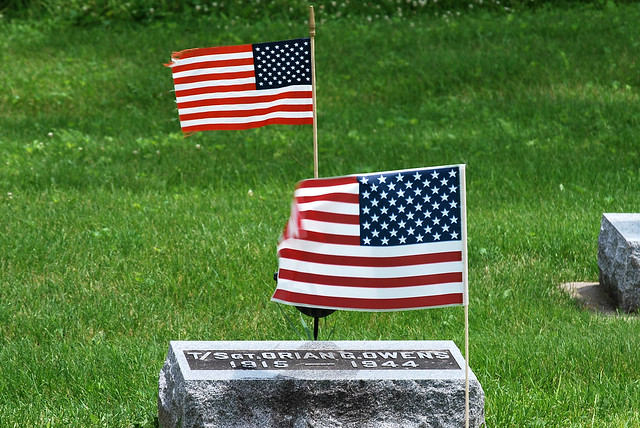
A big thanks to all who defended our freedoms. These particular WWII markers reside in a small cemetery in Lisbon, Iowa. While the property is small in size one of the cemetery's military heroes had been featured in my blog previously, Orian Owens as well as the Gettysburg battlefield boulder.


Thursday, July 3, 2014

Price of Freedom - Orian G. Owens


During World War II Orian G. Owens' B-17F was shot down over Holland on a return bombing raid to Germany on January 11, 1944. He and other crewmates parachuted out and were recovered by resistance fighters. In April German SS found the crew, interrogated the Americans and shot them in what is now known as the massacre of St. Remy. After the war, Orian's body was returned to his family for burial in the Lisbon Cemetery. Read my article about him here.

Wednesday, March 6, 2013

A Visit to Lisbon Iowa's Historic Standing Rock


Years ago while sitting through a college lecture on Iowa geology I learned of various house size boulders that lay scattered around the state, courtesy of a past glacial advance. Interesting I thought, and filed it away.

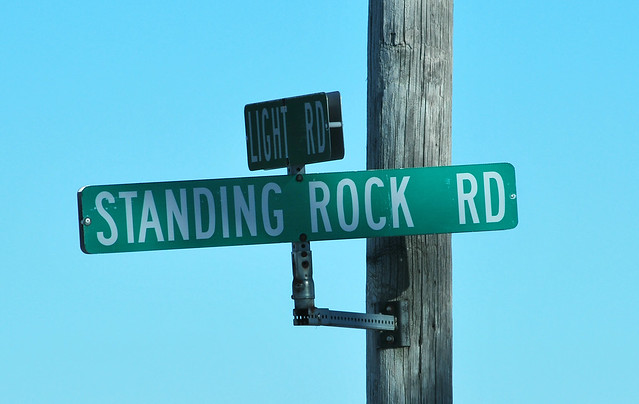
Fast forward to today. I looked for a location near Lisbon, Iowa by using a detailed map on my smartphone. The map contained names of county roads. There it was, Standing Rock Road. Suddenly the long ago college lecture came roaring back. After a quick aerial map search of the road and farm properties I came up empty with the location of the boulder. Determined to find the rock, I went to Lisbon last week, found Standing Rock Road, traveled the entire length of the road three times but the boulder remained elusive.


Finally after receiving some instructions to the boulder from the Lisbon Historical Society I located the granite structure.

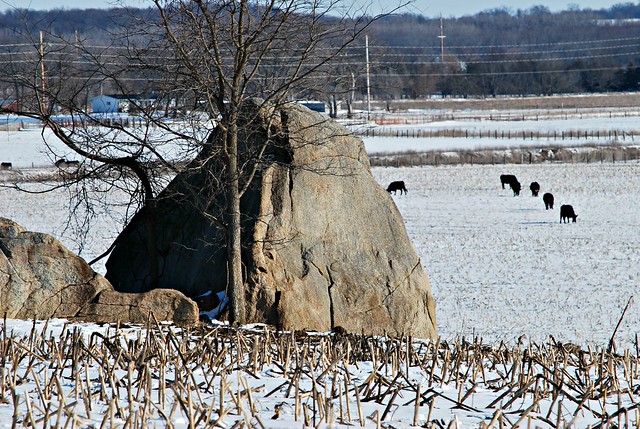
Standing Rock is located on private property in the middle of a corn field and is situated on the slope of a small hill. It is located about a mile or so west of Standing Rock Road. There must be a story there as to why the road and the structure don't more closely relate. The people at the historical society said the best time to see the rock is before planting or after harvest. Otherwise the structure is difficult to see.


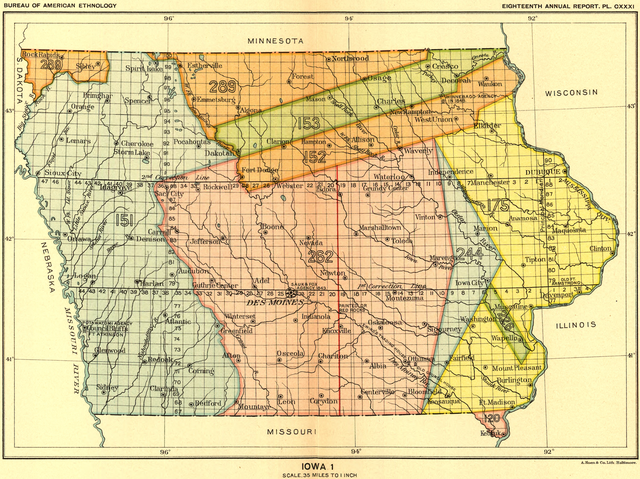
Standing Rock has been used by humans for a long time. The well rounded grey granite was purportedly used as a marker to define a boundary of the Black Hawk purchase by the U.S. federal government of lands owned by the Sac and Fox tribes in 1832. On the Iowa map (above) the Black Hawk Purchase shown in yellow. Standing Rock's location is at the apex of right facing green arrow - pointing to the yellow purchase. This long standing belief has been investigated at the National Archives collection but without actual confirmation documentation - yet. Still it is an imposing sight to see a house size boulder resting on fertile Iowa soil.

Discover Standing Rock for yourself. Take Iowa Highway 30 to Lisbon, Iowa. On the south side of town along Hwy 30 is a golf course named Hillcrest Country Club. Turn south on Country Club Drive for about a mile, then veer right on Standing Rock Road. You are traveling south on that road until it ends in a couple of miles. Turn right (west) at the T intersection at Day Road. Go about a mile and a half west. Standing Rock will be on your left a short distance from the road in a field. It is located across the road from a property filled with many old vehicles and machines. The field where Standing Rock sits is surrounded by what looks to be an electric fence. GPS coordinates: 41°52′27″N, 91°24′47″W.

Sunday, March 3, 2013

Snowy GAR Gravesite


Last week's snow almost buried the headstone of a veteran of the Civil War and Grand Army of the Republic (GAR) member in a small cemetery south of Lisbon, Iowa. The GAR, a fraternal and political organization dissolved after the last living Civil War vet passed, however GAR is supported today by other groups dedicated to preserving the gravesites of Civil War veterans. This particular grave is located close to the authentic Gettysburg Battlefield boulder which was officially secured and transported to Lisbon's cemetery in 1916.

Saturday, June 30, 2012

Union Pacific's Steamy Summer Rails


It is summer - no doubt about that. Last evening a powerful thunderstorm flared up over 42N land, dumping much needed rain and producing winds at up to 65 mph. Today, like yesterday, is again hot and very humid. How hot is it you ask? Hot enough for the air above the steel rails of the Union Pacific railroad at Lisbon, Iowa to produce mirages of wavy lines. Look for yourself. The only photo manipulation to this image is color correction and cropping.

Saturday, November 19, 2011

Lisbon House Fire Contained By Multiple Community Firefighters


Yesterday while in Mount Vernon, Iowa one, two, then three fire trucks rolled by. A few minutes later a fourth one sped off to the east towards Lisbon. Camera in hand, it was time to go to see what was happening.

Lisbon is located just a few miles east of Mount Vernon along the Lincoln Highway. Downtown was filled with smoke when we arrived. A house just a block south of Main Street was on fire. 


We arrived on South Jackson Street to see several fire and rescue vehicles trying to contain a one house fire. Many people including some local firefighters from Lisbon were in transit to the UNI dome in Cedar Falls for their local high school football championship game.

As a precaution other town fire departments were recruited to fill in if needed. On this dry, cold and windy day the help was needed.


While the fire remains under investigation the newly remodeled section of the house was the area that received the most damage. The family was away from the home when fire broke out but were onsite during the emergency. Their pet dog did not survive.

Local media present at the scene included KGRG television and the Gazette. Watch and read more about the story here.

Firefighters from Lisbon, Mount Vernon, Mechanicsville and Solon were on the scene - and maybe more. The duration and characteristics of the fire meant that the fire personnel rotated in and out of the house, changed oxygen tanks often and answered to many chiefs. Their combined effort fortunately limited damage to one house. We as a society don't pay these firefighters enough to do what they do.


Soon after the fire was contained, the multiple town crews began to transition into a cleanup and monitor mode. This firefighter had his outfit sprayed to wash off blackened soot. Later in the afternoon the home was secured.

Having the camera present during various times allows for recording some great images. Sometimes the opportunities are simple, like photographing a dragonfly's wings, other times the subjects are more dramatic. Know that.

Friday, November 11, 2011

Veterans Day 2011: Remembering Orian G. Owens

Tech Sergeant Orian G. Owens, WWII
Today through the power of the Internet and firsthand research brings into focus the special story of a fallen veteran from the 42N area.

Three weeks ago a stack of papers bought at auction in Coggon, Iowa yielded among other things, a small booklet called the Lisbon High School Alumni Directory 1880 – 1952. In the booklet are very brief updates of the then living or deceased high school classmates. I flipped through the pages, and stopped on one entry for the class of 1935. There among the time period of World War II was a six sentence description of a graduate who served in the Army Air Corps, was shot down, hid by the Belgium Underground and later shot by the Germans.

I was intrigued with this particular listing and went into research mode to find more information about Tech Sergeant Orian G. Owens and what happened to him. Here is his story for Veterans Day:

Following his Lisbon High School graduation in 1935 Orian George Owens (born Jan. 22, 1915), a farm boy, moved to the West Liberty, Iowa area in Muscatine County. Orian’s brother Harold graduated from Lisbon a few years later.

In 1942 Orian became one of 61 Muscatine county men who passed their physical examinations at the Camp Dodge (near Des Moines) induction center. On Aug. 27th Orian left Muscatine for the U. S. Army at Fort Leavenworth, Kansas, where he was assigned various duties.

Due to his farm machinery background Orian was assigned to the Army Air Corps and trained at the Shephard Field, California, Panama City, Florida and Salt Lake City, Utah. He became assigned to the 469th Air Force Bomber Squadron at Dallas, Texas where he became a First Engineer and top turret gunner on a B-17F Bomber. During a training exercise the landing gear jammed and Orian had to squeeze himself through the wing to manually lower the gear.

After training, Orian was sent to England and based at Thurleigh. His B-17F (tail number 42-30782) Bomber was nicknamed, "Rationed Passion." On January 11, 1944 the plane was part of 663 heavy bombers of the 306th Bomb Group. The target for Orian's tenth mission was a manufacturing plant in Halberstadt, Germany.

On the return trip, the plane was hit by flak and crashed in Holland. At that time the Germans occupied Holland, Belgium and France. Orian was injured when his parachute opened and then broke a rib upon hitting the frozen ground.

Orian and other crew members were picked up by the Dutch Resistance. Orian was hidden in a potato cellar with two other crew members. He was later escorted to various homes, barns and other shelters along with the other crew members. Still later the Dutch and Belgium Underground picked up the "Rationed Passion" crew and other downed airmen and moved them to the woods near Chimay and Saint Remy, Belgium, close to the French border.

On January 28th the Muscatine newspaper reported that Orian’s father had received notice that Orian was declared missing in action. At this same time Orian’s brother Harold was a POW under Italian control.

The group of ten U.S. airmen, including Orian waited for conditions to improve for them to be moved to France, then Spain and finally England. In the mean time the Germans closed the routes and the ten airmen had to wait for new escape routes to be established. Two men decided to escape on their own and later were successful.

Orian’s group of eight airmen had just concluded breakfast at 8 AM on April 22, 1944 when the sound of rifle fire came nearby. Nearly 1500 German SS soldiers flooded the area looking for the protected airmen and members of the underground. Orian’s group left the wooded area and was taken into German custody in Chimay. They were interrogated, stripped of their dog tags, false papers and money. After a three hour interrogation the men were loaded onto a truck with guards and headed back to the woods.

Once in the woods the airmen were escorted by two German soldiers each to a certain spot where they were lined up with their hands tied behind their backs. Then the group was separated with each airmen going in a different direction with two soldiers. A signal was given and the Germans shot the airmen in the back of their heads. The bodies were buried in a mass grave near Gosserlie’s airfield. Much later the grave was discovered and the bodies were transported to the military cemetery in Margraten, the Netherlands.

The eight airmen killed that day were from three different aircraft.

George Eike, B-17G “Susan Ruth”, Rochester, NY
Robert Benniger, B-17G “Susan Ruth”, Pittsburgh, PA
John Pindroch, B-17G “Susan Ruth”, Cleveland, OH
Vincent Reese, B-17G “Women’s Home Companion”, Philadelphia, PA
Orian Owens, B-17F “Rationed Passion”, Lisbon, IA
John Gramborsky, B-17F “Rationed Passion”, Chicago, IL
Charlie Nichola, B-17F “Rationed Passion”, Stockton, CA
Billy Huisch, Douglas, AZ

Five months later, the U.S. Army declared Orian as Killed in Action since no one had seen him since the capture. Again his father, George received word of the matter from the War Department. Orian’s brother, Harold, once held as POW was able to escape and rejoin his unit after a 500 mile journey.

After the war, Belgian military authorities tried the main culprits who carried out what is now known as the Massacre of St. Remy. In 1947 four men were sentenced to death while another two served jail time as a result of their complicity in the matter.

The crash of Orian’s B-17 ten member bomber resulted in five KIAs, three POWs and two airmen who evaded capture. In 1948 Orian’s body and other fallen veterans was recovered from Margarten cemetery for transport back to the United States. Flag draped caskets, coming from the war theaters were brought to America at intervals throughout 1948. Last honors were accorded to the serviceman at funeral and burial rites. Final interment was in the cemetery chosen by his next of kin.

Orian’s father George requested that his son be buried next to his mother at a cemetery in Lisbon, Iowa. A military funeral for T/Sgt. Owens was held on November 4th, 1948 at the Federated Church in Lisbon. Orian was awarded the Purple Heart, Air Medal and the Oak Leaf Cluster posthumously.

The town of Lisbon continues to honor its war dead. A new monument to the fallen veterans of Lisbon contains Orian’s name among the list of war dead. Periodically the Lisbon History Center conducts cemetery walks called, “Walk Through the Past” so that stories like Orian’s continue to be told. Know that.


Saturday, December 4, 2010

Gettysburg Battlefield Boulder in Lisbon, Iowa


Its hard to believe that not everything in the world lies on the 42 North parallel. However within just a few degrees either way of the famous latitude there are actually more interesting people, things and places.

Located in nearby Lisbon, Iowa (41.92 N, 91.39 W) is something from half a country away. In 1916 the Womans Relief Corps obtained a large boulder from the Gettysburg, PA (39.83N, 77.23 W) battlefield and had it moved to eastern Iowa's Lisbon Cemetery. The apx. five foot tall boulder is sheltered from the elements and contains a bronze plaque. The battlefield remnant is made of the same rocky material as the current day stone walls found around the historic battlefield. At the base of this stone are bronze markers with the names of America's wars.

Just a few feet away is this concrete triangular base. I suspect it held 10 canon balls like those found at many military displays. Either that or its a buried golf ball from Dwight Eisenhower who maintained a house adjacent to the battlefield and was known to play much golf after serving as President. Know that.

Wednesday, October 6, 2010

Original Lincoln Highway Posts Still Present in Linn County, Iowa


The Lincoln Highway bisects 42N country's Linn County. Here in Lisbon, Iowa is one of three original concrete posts left in the county with a bronze colored profile of old Abe and the red, white, and blue color scheme that identified the road with the big "L."

East Main Street in Lisbon, like many other Lincoln Highway communities has posted historic route signs along the route. Other cities have painted telephone poles or fly flags to mark the route. Some of the Lincoln Highway route changed over time and those portions are also marked - sometimes.

In Linn Country there are a series of Lincoln Highway displays that begin at the Lisbon History Center. There you can see the route through the county as well as read about the road itself, gas stations, overnight cottages, restaurants (where mobsters from Chicago in the 1920s-30s stopped) and so on.


In Lisbon, this LH post (close-up of medallion portion) still exists for all to see for 80 plus years. Go see it or some other LH post in your community. Send me your photo next to your version of the Lincoln Highway, Route 66 or National Road (Pike) type of historic route. Let me know what the road means to you. Know that.