Showing posts with label American Indian. Show all posts

Monday, August 31, 2015

Chief Keokuk Oversees the Mississippi River


Atop a limestone bluff overlooking the Mississippi River in southeast Iowa is the gateway city called Keokuk, named after the region’s Sac and Fox warrior chief. He died during 1848 in Kansas. The Chief's remains and "other materials of historic value" were reinterred at the base of this moment in the city named in his honor. The town is one of Iowa's oldest communities as explorers coming up the Mississippi stopped at the confluence of the Des Moines and Mississippi Rivers to settle. Later the town became one of the jumping off points for pioneers setting out on the Mormon trail to Salt Lake. Its a very historic town that brims with the sights of the past.

Saturday, April 18, 2015

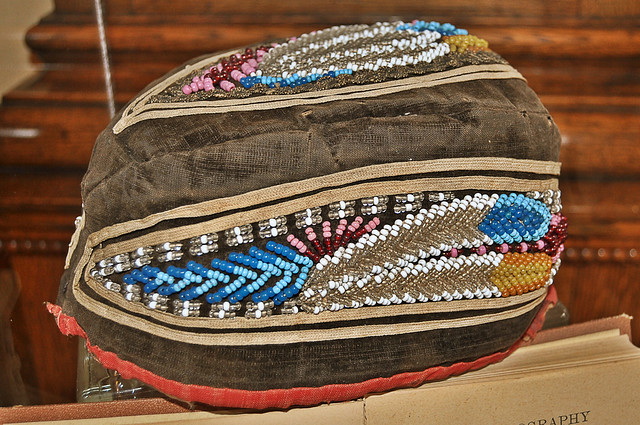
Chief Black Hawk's Hat in Exchange for Food


Sauk and Fox Chief Black Hawk continues to be studied here in the Midwest. Long after the 1832 Black Hawk War, his arrest near Prairie du Chien, Wisconsin and later death in 1838, he remains a strong influence on the region and in American lore. At the Des Moines County Historical Museum in Burlington, Iowa situated in the heart of Sauk and Fox country the chief's hat and autobiography were on display earlier. The revolving exhibit may have closed by now.


A nearby sign near the chief's hat reads that Mrs. Evan Evans received this beaded hat from Black Hawk in exchange for food. Mrs. Evans' great, great granddaughter donated the hat to the Burlington Free Public Library in 1965.

Following his death, Black Hawk's Iowaville grave was dug up and his bones removed. His remains were to have resided in an office in Burlington shortly after their removal. That office was destroyed by fire and presumably his bones were lost too. But there is growing speculation that Black Hawk's bones may have been stored in an office across the street and therefore survived the fire. The physical trail ends there at the moment but his legacy lives on.

Sunday, August 31, 2014

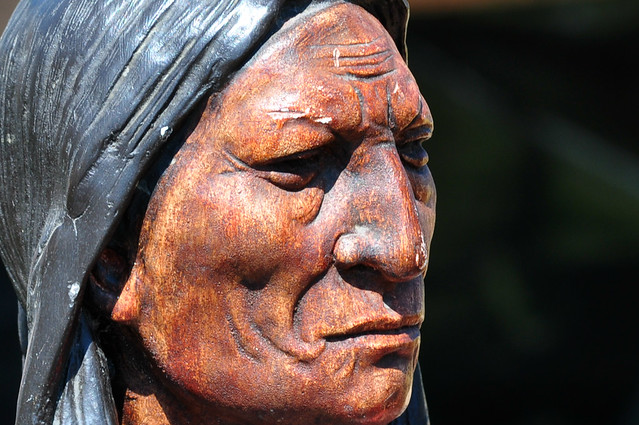
Marquette, Iowa Flea Market Stare


A stare from a native American bust/statue/figure head at the Marquette, Iowa flea market looks over the Mississippi River from underneath the Iowa-Wisconsin bridge today. The colorful plaster was listed at $25. The flea market continues into day 3 of the Labor Day weekend event in Marquette, located just across the river from Prairie Du Chien, Wisconsin.

Sunday, June 22, 2014

In Search of Ancient Americans - A Bill Anderson Presentation


Retired educator Bill Anderson spoke to a packed room at the English Valley History Center on Sunday, June 22, 2014. His topic was In Search of Ancient Americans and dealt with native tribes of southeast Iowa. Bill's opening remarks focused on his experiences as a middle school social studies educator and administrator.

Half jokingly Bill told the audience that there are four things that he would never do again if given a chance. Those being not to substitute teach, be a principal, officiate sports or drive a bus of kids.

Bill, who has a deep love of history and archeology has researched and collected items around North English and southeast Iowa for decades. He displayed an extensive collection of artifacts for his one hour presentation to demonstrate tools used for hunting and cooking. Bill's interest is to find evidence of ancient human existence and try to determine how those people lived.

While it is commonly believed that the Bering Strait land bridge allowed people to migrate from Asia to the Americas, Bill's talk focused on the period of European contact within Iowa. He explained that the Ice Age retreat of the glaciers probably led to conditions where mammoth kills took place. Currently there is an active dig of a mammoth herd near Ottumwa, Iowa. A search for a human connection to this site continues.

Bill showed examples of tools used by native cultures including arrowheads, mulls, axes, atlatls, plumb bob, game rock and fire crack rocks.

In Iowa Bill said there are 26,000 known native archeological sites, 348 sites alone in Iowa County. The state's archeological office estimates there are up to two million sites in Iowa. His talk in front of roughly 50 people also covered a summary sketch of Chiefs Wapello and Keokuk of Iowa plus Sauk & Fox warrior, Black Hawk, who to the surprise of many, was not a chief. All three leaders were present in the North English area from time to time.

"We need to teach more of the heritage of Iowa from all societies in our schools today," said Bill. "We can learn much more from them."

Wednesday, January 15, 2014

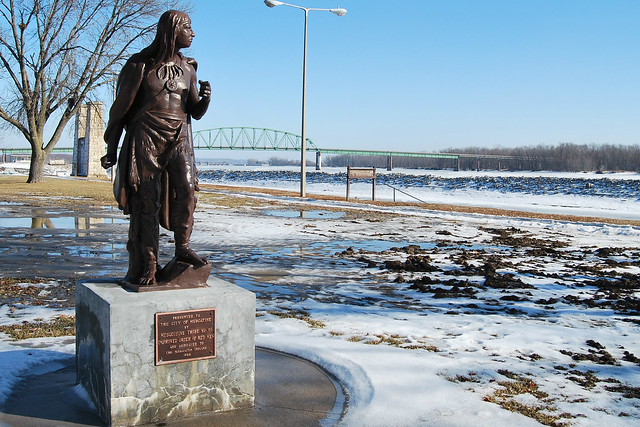
A Muscatine Look from Iowa to Illinois


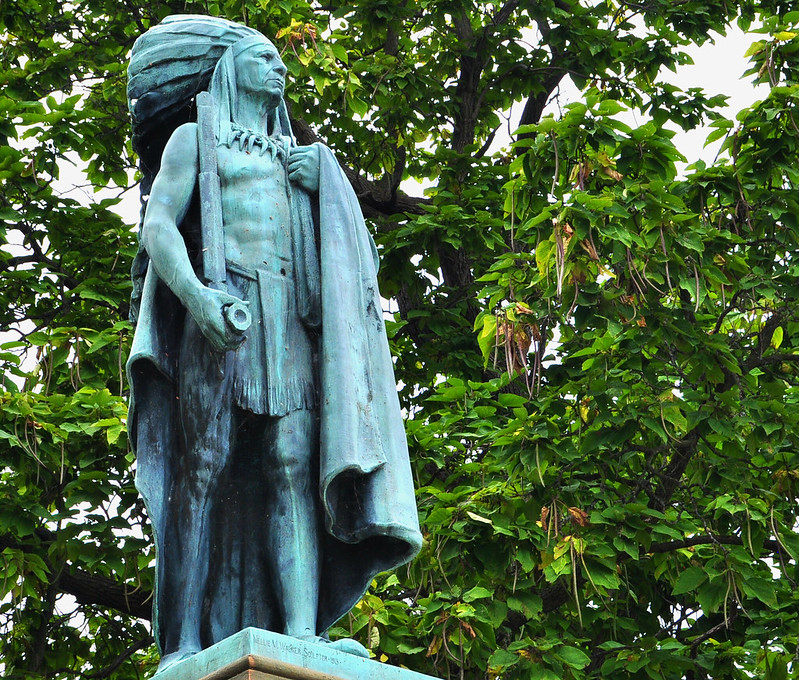
A statue looks across the Mississippi River from Muscatine, Iowa to Illinois.What really makes this scene a head scratcher is the spelling of Muscatine as found on the plaque. 

It reads,"Presented to the City of Muscatine by Musquitine Tribe No. 95, Improved Order of Red Men, and dedicated to the Moscoutin Indians 1926." Take your pick of the city's spelling. My guess is that its probably a progression from Native to French to English.

Friday, October 12, 2012

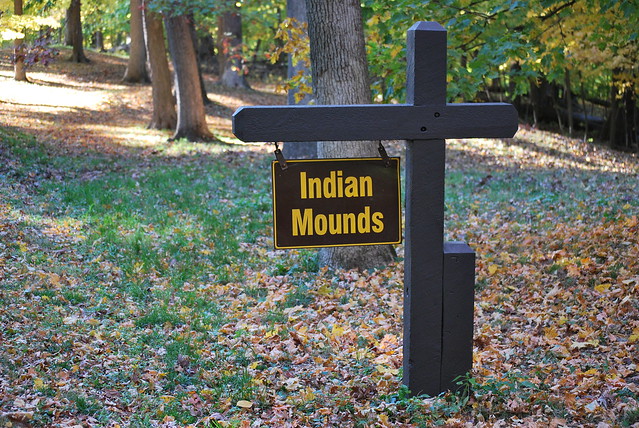
Indian Mounds of Palisades-Kepler State Park


Along a road from the park ranger's office to the camping ground within Palisades State Park near Mount Vernon, Iowa a sign identifies the site of several Indian mounds. Unlike the more famous Effigy Mounds in extreme northeast Iowa where the mounds are animal shapes, these mounds are slight rises roughly conical in shape and perhaps 3-4 feet high. Visitors are free to walk throughout the mounds and interpret their meaning. No informative signs are present to describe the mounds, their builders or their age. At this time of year the park is filled with people enjoying the change of color and warm temperatures. 

While I photographed the scene, several cars slowed to look at the mounds. Only one car stopped. Two people got out, walked over and clicked a quick photo then left. For the twenty minutes that I spent at the site, no one else stopped to inspect these ancient monuments. Isn't it interesting that modern visitors drive by historic sites, grab a quick photo and dash to the next scene? I've seen this behavior before at many historic sites. Perhaps the limitations of time or the mobility of the visitor are to blame but an extended stop may help people understand a bit more of the site and make for a richer experience.

Wednesday, April 14, 2010

A Wow POWWOW

The 17th annual University of Iowa POWWOW was held on April 10th and 11th in Iowa City. The event was hosted by the American Indian Student Association. The dance floor was ringed by drummers from different tribes who played and sang songs in either Northern or Southern styles.

Several types of dance (men's and women's traditional, men's and women's fancy, grass dance and jingle) were performed by dancers of all ages. Dancer outfits were especially colorful and laced with symbolism including the the silvery jingles which were fashioned out of tobacco chew container tops.

Two highlight presentations stood out. The first was the Grand Entry which began with a color guard bringing in national and tribal flags. The flag holders, attired in traditional military service themes, marched in the typical manner (as seen during sports events) but added a style that blended cultures. The flag holders were followed by all dancers in a precise order.

The second dance highlight was the Snake Dance. Consisting of all dancers the performers traced a pattern resembling a snake. Then they coiled the formation and finally stretched out much like a...snake. Very colorful and fascinating to watch.

Outside the ring of dancers were vendors and information kiosks. One booth offered wooden pens carved in the shape of animals. I purchased black bear and buffalo pens. Also offered were jewelry, clothing, paperweights and original artwork. Know that.