Showing posts with label Black Hawk War. Show all posts
Saturday, April 18, 2015
Chief Black Hawk's Hat in Exchange for Food
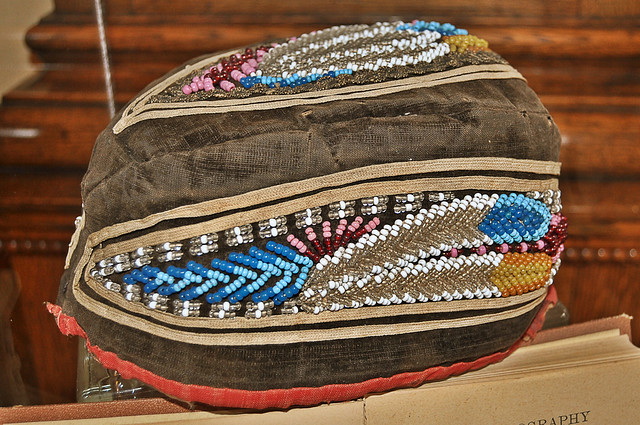
Sauk and Fox Chief Black Hawk continues to be studied here in the Midwest. Long after the 1832 Black Hawk War, his arrest near Prairie du Chien, Wisconsin and later death in 1838, he remains a strong influence on the region and in American lore. At the Des Moines County Historical Museum in Burlington, Iowa situated in the heart of Sauk and Fox country the chief's hat and autobiography were on display earlier. The revolving exhibit may have closed by now.
A nearby sign near the chief's hat reads that Mrs. Evan Evans received this beaded hat from Black Hawk in exchange for food. Mrs. Evans' great, great granddaughter donated the hat to the Burlington Free Public Library in 1965.
Following his death, Black Hawk's Iowaville grave was dug up and his bones removed. His remains were to have resided in an office in Burlington shortly after their removal. That office was destroyed by fire and presumably his bones were lost too. But there is growing speculation that Black Hawk's bones may have been stored in an office across the street and therefore survived the fire. The physical trail ends there at the moment but his legacy lives on.
Saturday, December 15, 2012
Black Hawk War Era Fort Stands at Sinsinawa Mound
You usually don’t associate the word “fort” with the American
Midwest, let alone the upper Midwest . Sure
they exist, even in Iowa ; places like Fort Madison ,
Fort Atkinson
and Fort Dodge .
These fortified structures provided a place of safety, collection of a garrison
and exerted regional control over the expanding territory as the United States
pushed over the continent.
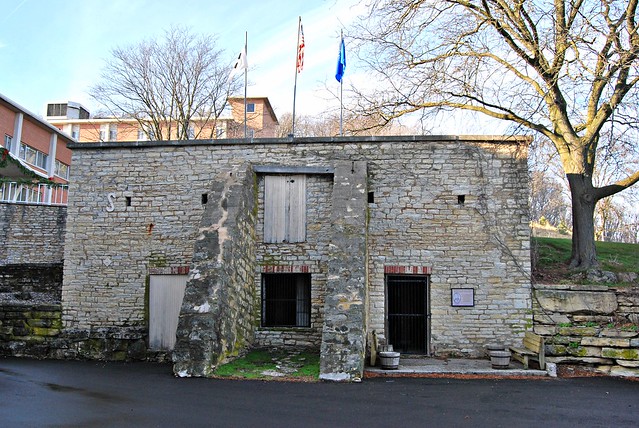
So it’s little wonder that while traveling just outside of Iowa near Sinsinawa , Wisconsin (an unincorporated community just a few miles
east of Dubuque , Iowa ) that this structure sticks out oddly
as does the mound it rests upon.
Extreme southwest Wisconsin
consists of rolling prairie hills. Prominent at Sinsinawa is a conical hill
that dramatically rises off the landscape and is topped off by a crown of
trees.
Early settlers farmed and raised livestock in the area –
much like the practices today. Lead was mined and smelted on the mound. When Sac (Sauk) and Fox factions threatened the well being of settlers a fort was constructed.
Local resident, later one of the first two Iowa Senators, George Wallace Jones
built this structure.
A display sign at the fort reads, “In the spring of 1832, at
the outbreak of the Black Hawk War, I built a log fort or block house for the
protection of my family…and neighbors.”
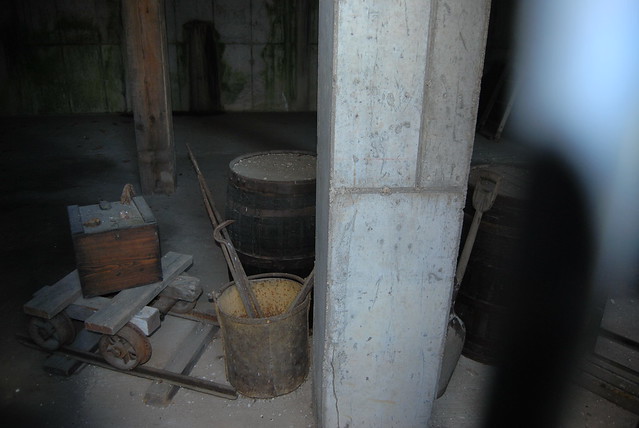
While I have not fully investigated the stone structure, it
is obvious that the building was recently preserved with concrete flooring and
column supports. The interior displays old lead mining equipment.
I have marked this as a subject to more fully explore. To
make it even more fascinating is the fort’s assimilation with the buildings of the
Sinsinawa Dominican Congregation of the Most Holy Rosary. The site is motherhouse
for 600 sisters who conduct educational training and spiritual relationships –
just steps outside the fort.
Subscribe to:
Posts (Atom)