Showing posts with label grain. Show all posts

Saturday, June 20, 2020

Grain Bins of Lisbon, Iowa


Just north of Lisbon, Iowa is a farm with these grain bins on the property. Bins shelter harvested corn or soybeans for livestock feed or delivery to market. On this day, a cold front passed through and offered a more dramatic sky than normal.

Wednesday, June 17, 2020

Capcom to Iowa - We have Grain


Modern grain bins dot the Midwest landscape. Looking like huge Apollo command and service modules (or Orion capsules in modern space exploration terms), some bin complexes contain grain transport tubes that resemble construction cranes. In Iowa, these massive structures store corn and soybeans. This bin is one of several located near Haverhill.

Tuesday, June 16, 2020

Jesus of Haverhill, Iowa


Located in a small Catholic cemetery in Haverhill, Iowa is this life size crucifixion display rising out of the farmland. The rural area is dominated by corn and soybean fields, farms and grain elevators. A black and white treatment of the image brings out the contrast of the cross with the Jesus icon and clouds.

Tuesday, April 26, 2016

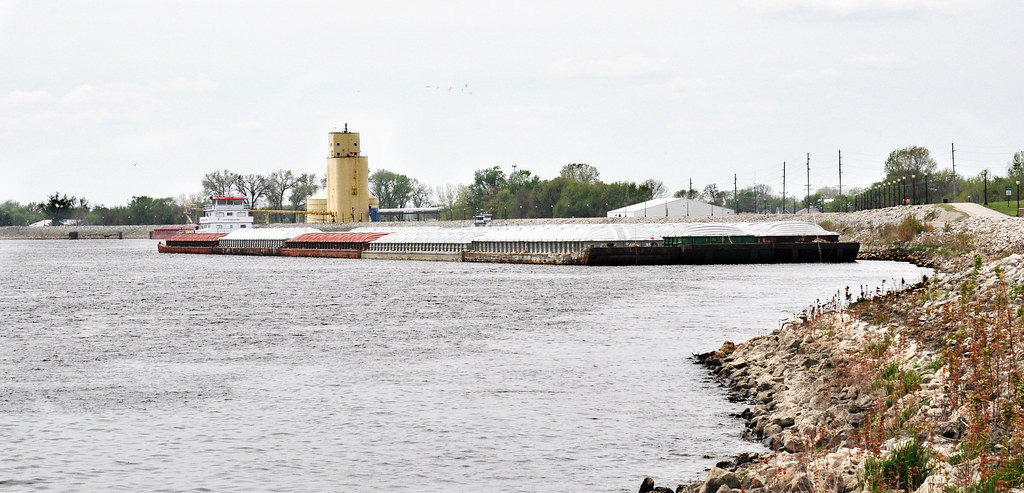
Barge Work on the Mississippi River at Muscatine, Iowa


River commerce is alive and well on the Mississippi River. Barge traffic is quite common along this portion of the river at Muscatine, Iowa where grain and other terminals are located. Marquette Transportation Company's Jacob Michael Eckstein, an inland towboat positions a 15 barge array for the journey northward.

According the U.S. Coast Guard database, the Eckstein was once called the Seminole Princess. The vessel was built in 1984, is listed as 130 feet long and hails from St. Louis, MO. More data can be found here.

Saturday, November 21, 2015

Snow from Canada, Oh the Irony!


So I'm out looking for snow scenes to photograph since we received the first of the season white stuff last night and this morning. Locally 7.5 inches of wet snow blanketed everything. At the Quaker Oats mills here in Cedar Rapids, four hopper grain cars from the Canadian Pacific Railway were not spared from the frozen precipitation. Its the white cap of snow over word "Canada" that caught my attention. Snow from the Great White North is something generally expected, now it is confirmed! Good one eh?

Monday, July 27, 2015

Iowa's Most Abundant Grain Crop Looks Great During the Summer of 2015


This is Iowa. We are situated in the western corn belt of the United States. The state's soil type and near perfect growing conditions help produce record or near record amounts of corn annually. Most of the corn you see throughout the state is used as feed or turned into ethanol. However Iowa's sweet corn is some of the best around.


According to the USDA in 2014, Iowa corn farmers grew almost 2.4 billion bushels of corn on 13.2 million acres of land. This year (2015) Iowa is projected to grow over 2.3 billion bushels of corn on 12.6 million acres of land.

Tuesday, August 5, 2014

Rural Granary Along Abandoned Track


North of Vinton, Iowa is this old granary or mill. While its exterior is kept clean and painted, the structure is no more than a relic of the past. The trail to the right is on the site of a former railroad line. Rail cars stopped at the granary to be loaded with local produced grains.

These tall structures were probably more common throughout the Midwest grain producing areas.

While this structure still stands, modern replacements are either cylinder shaped grain bins located on individual farm property or most likely, the local towering grain elevators that dot small towns throughout corn and soybean producing states.

Wednesday, August 8, 2012

Leaning Towers of the Midwest

Tilted stainless steel bins dot the American Midwest landscape. An effect of a wide angle camera lens produces the appearance of these huge grain bins leaning toward each other - however in reality the view is conventional.


Many grain belt towns are populated with storage structures like these designed to hold the local harvest. More elaborate and expansive bin systems can be found in towns closer to railroads or highways. These particular collection of bins are located in Delmar, Iowa and are a few blocks from a highway that runs 27 miles to the Mississippi River. Grain processing facilities in the river port of Clinton further distribute the grain to area businesses for ethanol production, livestock feed or to other buyers by rail, truck or river barge.

Friday, July 13, 2012

Grain Bin Tower Communications or Something Else


Want to talk about grain and the 2012 summer's lack of rain? Then you need a big tower to get the word out to the masses. Not all is as it appears. Grain bins are located in the background of the tower. Three tracks of the Union Pacific railroad are just this side of the tower. As it turns out this tower is a relay tower for UP communications to its trains. Now you know.

Sunday, October 30, 2011

Breaking Prairie Sod in the Fall


A common sight in past autumns was the cultivation of soybean or corn stubble after harvest. This was accomplished with disk cultivators (like this one) plowing the ground under with the organic material deposited a few inches below the surface while exposing new soil to air and water. Resultant organic recycling leads to a superior seed bed preparation with the side benefit of cleaner looking fields.

But in the late 1980s this practice was phased out for better methods of soil management. Up until that time precious topsoil was often eroded by wind or water which did no one any good. Today fields are generally chisel planted as to be minimally impactual on soil. However there are times when it is necessary to till, such as when soil compaction is discovered, for optimized planting.

These rusting disks show remnants of some of the best soil in America for grain production. Proper soil management is as important as the annual harvest itself. Many farmers already know that.

Friday, December 3, 2010

Iowa's Temporary Mountains of Corn


What happens to the corn harvest when it is too plentiful for local storage capacity? Grain goes old school - on the ground.

In 42N country there are a variety of open air, temporary storage areas for corn and soybeans used during the harvest season. In this case the temporary storage area is a concrete floor and wall structure located in Manchester, Iowa. Skid loaders or tractor powered augers later move the harvest to grain transportation semi-trucks for further distribution.

One important development lately is a expandable, tent-like structure used by grain elevators to cover large grain heaps during harvest. The cover keeps the grain dust down, the elements and critters out, thus preserving the product for later sale. Know that.

Sunday, November 7, 2010

Grain Bins Hold the 2010 Harvest


As noted earlier in 42N blog posts, the countryside here reflects the grain agriculture nature of the Hawkeye state. In Iowa our mid-continent, mid latitude land is farmed primarily for corn and soybean production. These grains form the basis for livestock feed, fuel, or any number of things that manufacturers produce using these main staples (like starch.)

Small towns and rural crossroads with one or more bins like this scene above are quite common. Bins can represent storage and mixing facilities for livestock food. Feed mixture can be customized for a variety of livestock needs from poultry to cattle. Minerals and other additives can be mixed with corn or soybeans to deliver whatever the livestock producer requires for his/her livestock operation.

Steel bin imagery is often taken for granted because it is repeated so often around the region. These bins however, represent an important link from field to food, energy and material production around the world. Know that.

Thursday, September 23, 2010

Grain Processing Mills Ready for Fall Harvest


In many 42N country small towns local grain mills are ready to process the 2010 crop. Here in the southern portion of Iowa City (41°38'N, 91°33'W), near the municipal airport is a complex of grain storage bins and mills. This site is repeated all over the Midwest to the point where you hardly notice the structures. But venture outside the region or into urban areas and you will not see these iconic structures.

Some of the bins hold the harvest for later transport to distribution centers or local business consumers. Some of the bin contents are milled per individual specification for livestock feed like in the photo above. A stat that I found regarding the annual harvest of 12.1 million bushels of corn use in North America is: 
  • 44% livestock feed
  • 30% fuel production (ethanol)
  • 15% exports
  • 8% making food starches and sweeteners
  • 3% making corn flour, grit, meal and beverage alcohol. 
Nationwide, the corn harvest through September 20th is 18% complete. Know that.

Sunday, February 1, 2009

Plus Side of Living in Cedar Rapids

Canada geese hang out in below zero degree weather near the Quaker Oats and Cargill plants in Cedar Rapids, Iowa last week. What is the attraction to sticking around sub-zero quarters instead of someplace warm? The answer is food - lots of it. Where these geese hang out is one of the staging areas for grain trucks heading to the plants. Spills of grain by the waiting trucks accumulates on the road. This in turn attracts the large birds from the north keeping them well fed over the winter. Watch your step. Know that.