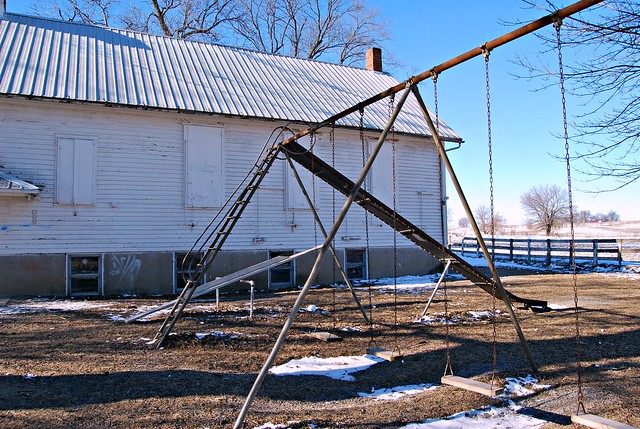
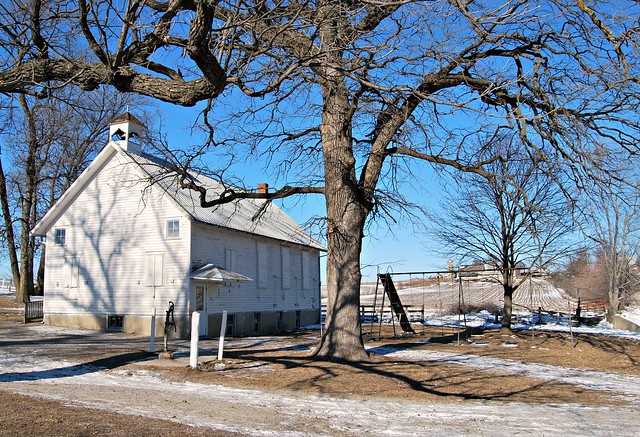
 Simplicity exists in 2013. East of Kalona, Iowa, in Amish country, a functional one room schoolhouse shows buggy marks in the snow and decorative snowflakes on the windows.
On New Year's Day the building was closed for the holiday while a mile or so north a group of Amish children played Ring-Around-a-Rosie outdoors in the near 20 degree weather.
Ironically to document this simplicity, a digital SLR camera was used to photograph the scene (aside from the travel technology used.) Then the file was uploaded to a PC, then sent to an online photo editor and later housed on Flickr. Ultimately the blog was assembled on blogspot and published. Simple.
Amish farmers near Kalona, Iowa looked to replace a family's barn in the 1990s. When my in-laws were selling their farm properties near Cedar Rapids, Iowa a deal was struck. The Amish would hire a driver, vans and wagons, come some 40 miles north, tear down the barn and reassemble it a few miles northeast of Kalona. The tear down phase took just a few days and involved a small army of Amish men. They drew a schematic of the barn, labeled everything (in pencil) including the oak pegs that held wooden beams together. Today the barn (center in photo,) originally built in 1916 by a relative, sits on a rise overlooking corn and hay fields. The new owners who have had the barn now for around 15 years have improved the structure by adding a new roof and updating some of the side walls. Hundred year old barns don't always come on the market. In fact the Amish are currently building a new barn just right of the photo on a neighbor's property.

.jpg)
.jpg)
42N country's Frytown, Iowa (latitude 41.57N, longitude 91.73W) is a small farming community in eastern Iowa. Located between Iowa City and Kalona the region is home to Amish and Mennonite families. Nearby is a FAA radio beacon used to guide intercontinental air traffic between coasts. On sunny days you can spot scores of jets flying nearly overhead from horizon to horizon going east to west and west to east. Little do the 21st-century air travellers know that 33,000 feet below them is a community that embraces some practices from the 19th-century.
While in Frytown for an auction (photo above from the horse hitch area of the auction house) an Amish farmer showed me how their clothes are pressed by irons made around 1900. The auction featured many local farm tools including the old non-electric irons. In return I showed him and two of his friends how my Blackberry works. They heard of the device but had not seen one demonstrated. The younger guy seemed the most interested and asked several questions including whether it had news of the earthquake in Chile that occurred that morning. His older friend offered a sceptical eye. Know that.
.JPG)
.JPG) The first Monday of the month brings a well attended horse sale at the Kalona Sales Barn in 42N country's Kalona, Iowa (41.48N, 91.70W.) This past Monday being Labor Day, and a perfect weather day, both combined to attract hundreds of people to the sale ring. Horses of many breeds and ages were auctioned as well as a wide variety of gear such as saddles, bites, ropes, blankets, feed, and what not.
The first Monday of the month brings a well attended horse sale at the Kalona Sales Barn in 42N country's Kalona, Iowa (41.48N, 91.70W.) This past Monday being Labor Day, and a perfect weather day, both combined to attract hundreds of people to the sale ring. Horses of many breeds and ages were auctioned as well as a wide variety of gear such as saddles, bites, ropes, blankets, feed, and what not.
Kalona is home to a large Amish community. They were represented at the auction as buyers, ring workers, cooks, and sellers. Plenty of Amish horse and buggies were also present at the facility in between the pick ups, cattle trucks and livestock trailers.
Highlights of the auction included a longhorn steer bull who sold for $800. On the horse side of the sale many working and hobby breeds sold. A brother-sister pair of work horses, ages 6 and 7 years old respectively, circled inside the sale ring together. The winning bidder had the opportunity to purchase both horses at $50 a piece, but after a long pause following the win decision she elected to only purchase one horse. Some people in the audience did not like that decision, especially a certain news person making her first trip to a livestock auction. Know that.
.JPG) A lone Amish buggy trots near Platteville, Wisconsin on Father's Day 2009. Since the year 2000 hundreds of Amish families have moved from Pennsylvania to southwest Wisconsin. The main reasons seem to be the much lower price of farm land and the lure of rural settings of the Midwest - away from the growing metro centers in the East. On this day a young man in black, duster-like rain gear navigates the rolling prairie, passing other wet Amish-worked fields. Know that.
A lone Amish buggy trots near Platteville, Wisconsin on Father's Day 2009. Since the year 2000 hundreds of Amish families have moved from Pennsylvania to southwest Wisconsin. The main reasons seem to be the much lower price of farm land and the lure of rural settings of the Midwest - away from the growing metro centers in the East. On this day a young man in black, duster-like rain gear navigates the rolling prairie, passing other wet Amish-worked fields. Know that.



.jpg)
.jpg)
.JPG)
.JPG)
.JPG)